
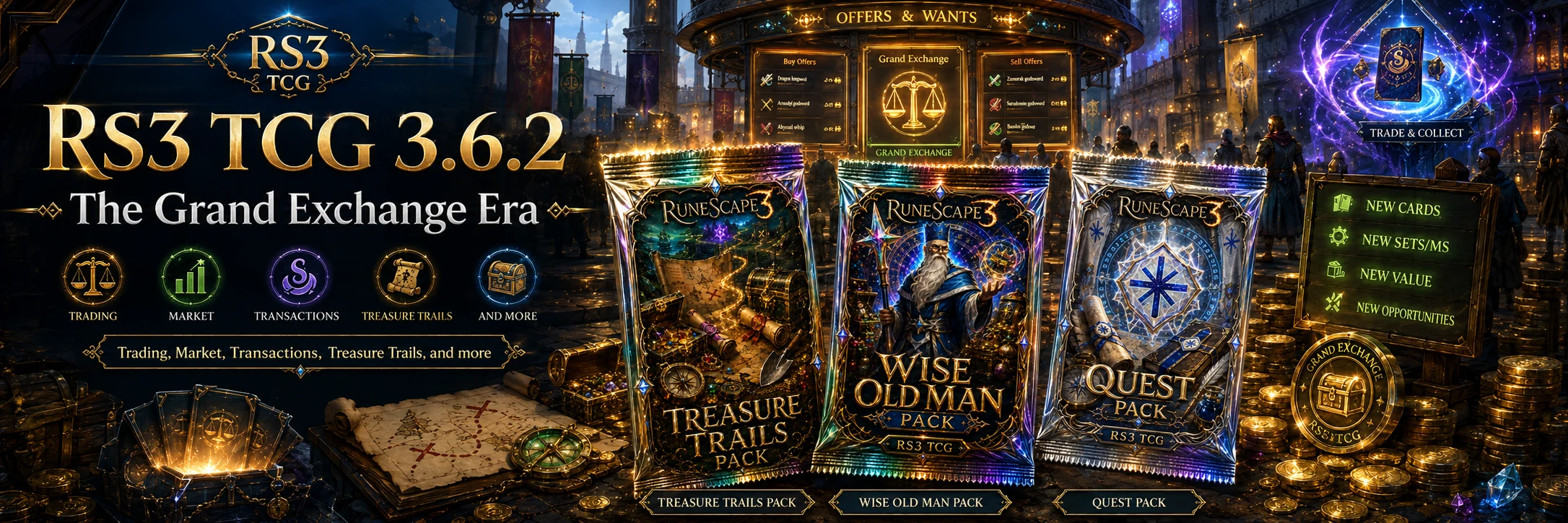
From collection tracker to living card economy
Version 3.6.200 is not a small patch wearing a larger coat. It is the point where RS3 TCG grows from a pack-opening and collection experience into a connected card economy. The production build is moving directly from 3.5.34, so this release gathers the entire 3.6 development line into one public launch rather than asking players to walk through more than one hundred internal steps.
The heart of the update is the new Grand Exchange. Cards are no longer objects that only enter a collection and sit there. They can be traded directly, listed for sale, requested through buy offers, transformed into higher rarities, dismantled for Foil Dust, or recycled into Chronicle Coins that also support community events. Every major path uses the same card visuals and variant rules, so a Normal copy, a Foil copy, and a Shiny copy remain distinct wherever they travel.
Trade Hall: begin with the card, not a blank form
The Trade Hall has been rebuilt around the question players actually ask: “Who owns the card I need?” Start a trade, search the catalogue, choose a specific Normal, Foil, or Shiny card, and the Trade Hall will show its owners. Selecting an owner opens that player’s available catalogue with the requested card already chosen, turning a previously abstract request form into a guided card-first path.
Offers can contain multiple cards and Chronicle Coins on both sides. Every card has an exact variant and quantity. The receiving player may accept the proposal, reject it, or counter by changing either side. Once both players approve the review stage, the trade locks into a final version that must be confirmed again before anything moves. The extra step is deliberate: it gives both players one last clear look at the exact cards and currency being exchanged.
Active trades retain a private modification history for the two participants. Proposals, counters, reviews, final locks, confirmations, cancellations, expirations, and completion all appear as a readable timeline. Alt1 notifications follow the current stage instead of leaving a trail of stale alerts, and the exact trade can be reopened from the notification center.
- Search cards or players and discover which players own a specific finish.
- Offer exact Normal, Foil, and Shiny quantities plus Chronicle Coins.
- Counter, review, lock, and confirm without losing the current offer after a reload.
- Keep trade history private to the participants.
- Use full catalogue cards, compact fans, keyboard focus, and stable pagination inside the trade screen.
Card Market: listings, buy offers, and readable prices
The Card Market provides the open-market counterpart to direct trading. Players can list a specific card finish, quantity, price, and duration. Buyers can purchase available quantities, while buy offers reserve Chronicle Coins for cards that are not currently listed at the desired price. Partial fills are supported, so a listing or offer can remain active until its quantity is exhausted or the order closes.
The market now separates the total wallet from the spendable wallet whenever coins are reserved. Listing deposits and successful-sale fees are shown before confirmation, oversized prices reveal their complete formatted value, and the market keeps the current card, values, page, and scroll position when a session token refreshes. The result is less form-reset whiplash and far more clarity about what is actually available to spend.
- Create sell listings for exact card finishes and quantities.
- Post buy offers with reserved funds and support partial fills.
- See deposits, sale fees, available coins, and reserved coins before committing.
- Review compact market activity for listings, purchases, sales, and offers.
Transmutation: turn duplicates into a path forward
Transmutation has changed from a recipe menu into a full workshop. Select cards directly from the collection, filter by rarity and finish, and let the workshop infer the recipe from the first eligible card. The selection area shows every sacrificed copy as a card, including repeated copies, and the permanent review makes the inputs, costs, and result rules visible before confirmation.
Normal cards can climb the rarity ladder from Common toward Mythic. Foil cards can follow the same path while consuming a rarity-scaled Foil Dust catalyst and producing a Foil result. The reward is not chosen from the entire game blindly: the source packs represented by the sacrificed cards vote on the reward pool. If half the inputs came from one pack and half from another, the review displays that exact split before the roll.
The workshop also supports selected reward pools, guaranteed Foil crafting, and Foil dismantling. Dismantling is the direct source of Foil Dust, while card recycling can now award additional Dust for Foil cards. Every successful craft ends with a dedicated full-card reveal instead of quietly changing a number in the collection.
- Automatic recipe selection from the cards chosen.
- Normal and Foil rarity upgrades with separate requirements.
- Source-pack-weighted reward chances shown as exact percentages.
- Selected reward pools and guaranteed Foil creation.
- Foil dismantling and rarity-scaled Foil Dust values.
Foils move, Shinies sparkle, and every finish stays independent
Foils now animate continuously across the app and website, with pointer-reactive lighting layered over their automatic motion. The finish library has expanded beyond a single effect, allowing cards to use treatments such as cosmic, rainbow, gold, starry, black-hole, Christmas, and skull-inspired designs while preserving the underlying card artwork and text.
Shiny cards are now a true third variant rather than a badge or a special Foil. They have their own ultra-rare drop chance, ownership total, discovery date, pack record, trade variant, market variant, reservation state, and catalogue filter. A Normal card never becomes visually Foil merely because another owned copy is Foil, and a Foil never becomes Shiny because the base card has a Shiny copy elsewhere in the collection.
Shiny pulls receive a dedicated reveal sound and starshine treatment. Foil, Shiny, rarity, and per-card audio cues have also been separated so one reveal no longer cuts off another. Timing controls and saved previews make the pack-opening soundscape much easier to tune.
A pack-opening stage built for every viewport
The pack-opening screen now reshapes itself around the available window rather than assuming a large desktop. Card width, row count, fan spacing, summary panels, reveal controls, and recycling tools all adapt to compact Alt1 viewports. Wide windows retain a cinematic row, while narrower windows use balanced multi-row layouts without shrinking the cards into postage stamps.
Opening multiple packs now produces a real wrapper stack and animated cascade. The Keep opening flow stays on the reveal stage, grouped notifications prevent a wall of repeated messages, and each card can be revealed directly by click or keyboard. Performance work reduces the amount of artwork and animation that remains alive after a card or dialog is no longer visible.
Pack Vault controls have been reduced to compact opening menus, while the Pack Shop and Vault use natural page scrolling instead of nested scroll traps. On narrow screens, product and vault entries become compact horizontal layouts that keep artwork, price, quantity, and the primary action together.
- Responsive one-row and multi-row reveal layouts.
- Continuous opening without returning to the Pack Vault.
- Grouped notifications and per-card reveal controls.
- Multi-pack wrapper stacks and animated cascades.
- Per-card, rarity, Foil, and Shiny audio with saved timing.
Treasure Trails arrives with 576 rewards
Treasure Trails is the largest single catalogue expansion in this release. The new Treasure Trails Pack contains 576 cards sourced from Easy, Medium, Hard, Elite, and Master reward pools. Cards retain source-tier information, published rate details where available, reward classifications, and selection weights tailored to the pack.
The pack introduces Divine rarity for the rarest rewards. Ultra-rare Reward Casket cards act as jackpot pulls, and the opening system records jackpot status alongside the card result. Weighted selection has been corrected so the advertised rarity and reward chances match the actual roll path rather than a simplified equal-card pool.
A local drop simulator lets players explore the pack without spending currency, while the Pack Shop and pack preview expose rarity weights, guaranteed slots, Foil chance, and event modifiers. Treasure Trails also receives its own catalogue navigation and artwork rather than being folded invisibly into a generic set.
- 576 reward cards across all five Treasure Trail tiers.
- Divine rarity and ultra-rare Reward Casket jackpots.
- Source tiers, known rates, reward types, and weighted selection.
- Dedicated wrapper, catalogue, preview, simulator, and opening support.
Community Treasury: recycling becomes community fuel
Players can now permanently recycle spare cards from the Cards page or directly after a pack opening. The old excess-copy rule has been removed. Players choose the exact card finish and quantity themselves, review the permanent action, and see the Chronicle Coin payout, Treasury contribution, Foil Dust recovery, and number of cards destroyed before confirming.
Normal and Foil cards can be selected directly, while locked, reserved, unavailable, and Shiny cards remain protected. Card controls stay hidden until a card is opened, then slide into a compact two-row panel with quantity and lock controls above the payout values. The layout is designed to fit beneath the card without creating another heavy block of interface chrome.
A share of each recycling value enters the Community Treasury. Public totals show available and reserved funds, lifetime contributions, distributions, returned funds, and recycled-card counts. Treasury milestones and contributor statistics turn individual cleanup into visible shared progress, while event funding can draw from the pooled balance.
Foil recycling also recovers Foil Dust according to rarity. Both Chronicle Coin and Foil Dust wallets now update immediately after settlement and show a temporary +amount indicator, so the reward is visible instead of silently appearing in the next refresh.
- Manual exact-card recycling with a permanent confirmation step.
- Chronicle Coin payout plus Community Treasury contribution.
- Foil Dust recovery for Foil cards, scaled by rarity.
- Locked, reserved, unavailable, and Shiny-card protections.
- Public Treasury totals, milestones, contributors, and personal recycling statistics.
Events can reshape the site and the Pack Shop
Events are no longer limited to a small announcement banner. The event system can now support Chronicle Coin multipliers, Pack Shop discounts, Foil and Shiny chance boosts, Rare-or-better weighting, bonus cards, guaranteed Foils, guaranteed Shinies, recycling-value boosts, Foil Dust boosts, Card Market fee reductions, Transmutation discounts, and announcement-only events.
When a major event is active, the website homepage can replace its normal hero with event artwork, a headline, effect details, scope, end time, and a direct action into the Pack Shop. Inside Alt1, event presentation now lives where players make pack decisions: the Pack Shop. Affected packs show their discount, boosted odds, bonus cards, guaranteed finishes, or other event rules directly on the storefront.
Multiple event effects can operate together, and pack-specific effects remain attached to their intended pack rather than leaking into unrelated products. Economy-wide events apply to the relevant public actions, including recycling, market fees, Transmutation costs, and currency rewards.
A faster catalogue, Trade Hall, and long session
Several of the most visible improvements in 3.6.200 are not new buttons. They are the removal of invisible work. Large catalogues now delay off-screen card rendering, closed dialogs release artwork and event handlers, and long-running sessions clean up images that are no longer needed. The Trade Hall uses static premium finishes inside dense trade screens to avoid repainting every Foil layer continuously while an offer is being reviewed.
The active trade screen no longer wraps every card in an extra shell. Cards appear directly, and hover movement is applied to the card rather than a blurred container. Pack opening, the catalogue, news, and account views also receive targeted memory and lifecycle cleanup so the app does not slowly become heavier simply because it has been open for hours.
Responsive work touches nearly every surface: the header, wallet, bottom navigation, Pack Shop, Pack Vault, Cards page, Trade Hall, Card Market, Transmutation, pack opening, and recycling controls. Keyboard activation and focus states have been expanded alongside the visual changes.
Account-safe RuneMetrics tracking
RuneMetrics tracking now keeps its baseline, pending XP events, quarantined events, tracking session, preferences, and evidence inside an account-specific browser partition. Switching RS3 TCG accounts can no longer cause one account’s baseline to be interpreted as another account’s progress.
An account change pauses tracking, discards stale responses from the old account, loads the new account’s state, and establishes a fresh no-award baseline. Tracking resumes only after repeated matching Total XP readings confirm that the display is stable. Authentication is also separated by Alt1 window and deployment path, so development and production can be open at the same time without overwriting each other’s session or refresh state.
The updater now treats a normal application version change and its matching refresh signal as one event. A release should reload once, acknowledge the matching signal, and continue, instead of updating and immediately performing a second administrator refresh.
- Per-account baseline, queues, sessions, preferences, and evidence.
- Fresh no-award baseline verification after account changes.
- Stale-response protection across account and window switches.
- Independent development and production browser state.
- Single-reload application updates.
News, achievements, and a clearer public archive
The website now includes a full news archive rather than relying on changelog bullets alone. Articles support headings, lists, callouts, images, quotes, buttons, reading times, categories, and accessible article navigation. This release post is the first example of that longer format and gives large updates room to explain how their systems connect.
The achievement catalogue has expanded alongside the new economy, cards, packs, and collection systems. During pack opening, achievement notifications wait until the card that triggered them is actually revealed, preventing the notification from spoiling a hidden pull.
The card-set navigation, public Events page, exchange activity, Treasury progress, and long-form news archive give the website a much stronger role as the record of the living collection rather than a static companion page.
What happens to existing players?
Existing production accounts, balances, collections, opened-pack history, achievements, RuneMetrics history, roles, sessions, and profile data remain in place. The release adds the new economy structures around that data and builds discovery and acquisition records from the production collection itself. No development players, balances, trades, market orders, pack histories, or testing transactions are carried into production.
The production card catalogue and pack definitions are updated to the 3.6.200 release data. Existing card and pack identifiers remain stable, so owned cards and sealed packs continue pointing to the correct catalogue entries while gaining access to the new systems.
Welcome to 3.6.200
This release is the largest structural change RS3 TCG has received. It connects collecting, opening, trading, crafting, recycling, events, and public progress into one loop while also sanding down the friction that appears on small windows and long sessions. The new systems are broad, but the goal is simple: every card should have more meaning after it enters the collection.
Open the Pack Shop, inspect the new catalogue, try the Trade Hall, explore Transmutation, and keep an eye on the Community Treasury. The archive has become an economy, and the economy now has plenty of room to grow.